How True Is It That AI Is Starting to Affect Our Critical Thinking?
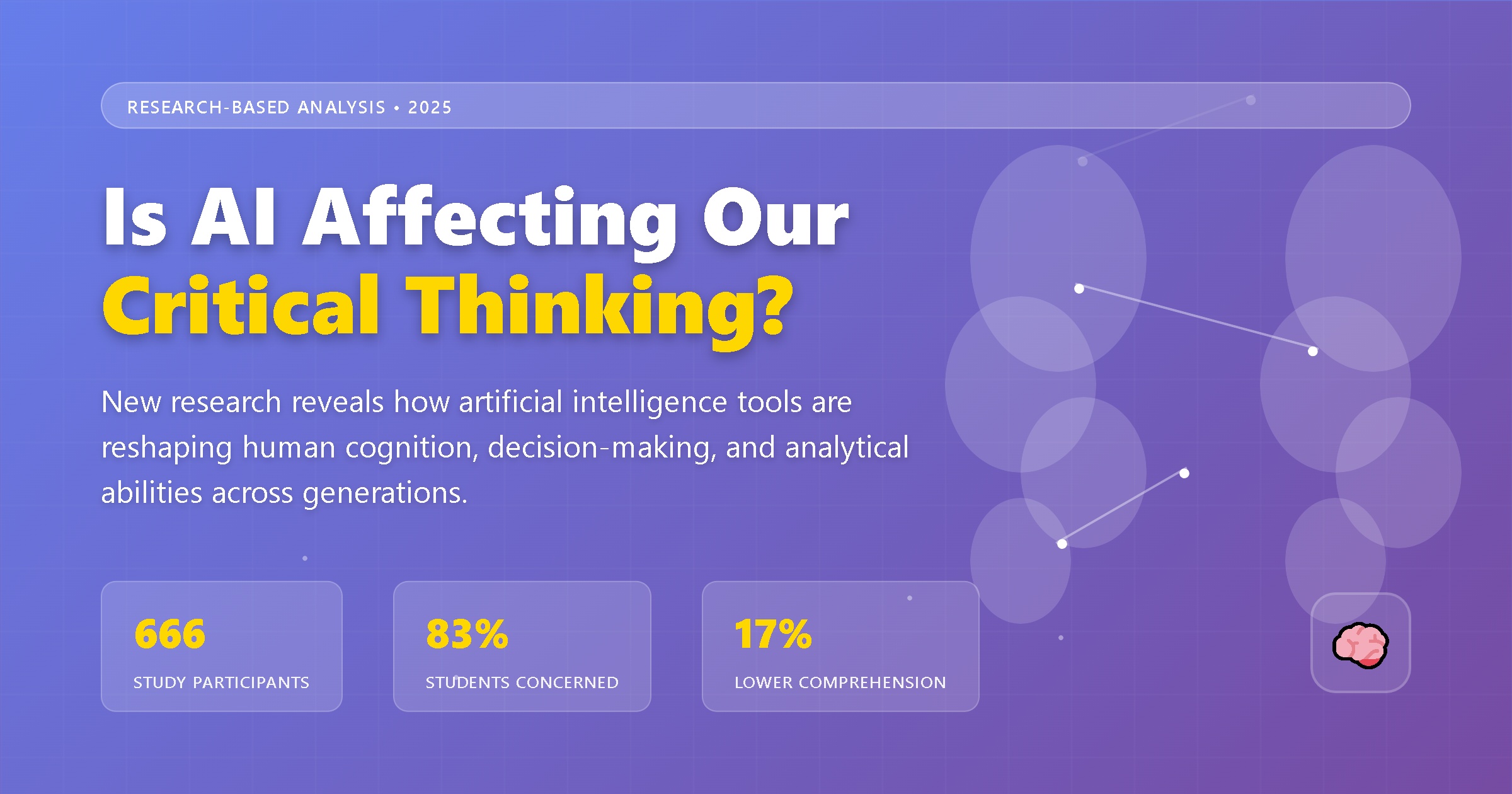
Table of Contents
Understanding the Real Impact of Artificial Intelligence on Human Reasoning
In an era where artificial intelligence tools like ChatGPT, Claude, and other generative AI platforms have become everyday companions, a pressing question emerges: Is AI genuinely affecting our ability to think critically? Recent research from 2024 and 2025 reveals a complex answer that every student, professional, and educator needs to understand.
The Evidence: What Recent Studies Tell Us
The Numbers Don't Lie
Multiple peer-reviewed studies published in 2025 have established a concerning trend. A comprehensive study analyzing 666 participants across diverse age groups found a significant negative correlation between frequent AI tool usage and critical thinking abilities. This isn't speculation—it's measurable, documented cognitive change happening right now.
Research demonstrates that increased reliance on AI tools correlates with diminished critical thinking abilities, with cognitive offloading identified as the primary driver of this decline. But what does this actually mean for you?
The Cognitive Offloading Phenomenon
Cognitive offloading refers to the practice of transferring mental effort to external aids—in this case, AI tools. While this sounds efficient, studies show that younger participants, particularly those aged 17-25, demonstrate higher dependence on AI tools and lower critical thinking scores compared to older age groups.
Think of it like this: when you use GPS navigation constantly, you eventually lose your natural sense of direction. Similarly, when AI handles your analysis, research, and problem-solving, those cognitive muscles begin to atrophy.
How AI Impacts Different Thinking Skills
1. Information Analysis and Evaluation
Knowledge workers report reduced cognitive effort when using AI for tasks like information retrieval and content creation, though they must now invest more time verifying the accuracy of AI outputs. This creates a paradox: AI makes finding information easier, but determining whether that information is reliable becomes more challenging.
2. Memory and Retention
Research comparing students using AI tutoring platforms found that while AI-assisted students answered 48% more problems correctly, their understanding test scores were 17% lower. This reveals a critical distinction between procedural performance and deep comprehension.
The concern extends to what researchers call "digital amnesia"—the phenomenon where outsourcing cognitive tasks to technology impairs our ability to learn and remember information independently.
3. Problem-Solving Independence
University students who used Large Language Models for writing and research tasks experienced reduced cognitive load but demonstrated poorer reasoning and argumentation skills compared to those using traditional search methods. Additionally, students using LLMs focused on narrower sets of ideas, resulting in more biased and superficial analyses.
The Dual Nature of AI: Enhancement or Erosion?
When AI Helps Critical Thinking
Not all the news is negative. AI can genuinely enhance learning when used strategically:
-
Personalized Learning: AI technologies can enhance learning experiences by automating routine tasks, thereby increasing the time students focus on higher-order cognitive activities
-
Data Analysis Support: AI can assist students in analyzing large datasets, generating hypotheses, exploring alternative solutions, and evaluating the consequences of their decisions
-
Measured Skill Improvement: Studies using AI-based learning media show significant improvements in students' critical thinking skills when properly integrated with traditional teaching methods
When AI Becomes a Crutch
The danger emerges when AI transitions from tool to replacement:
83% of students express concern that excessive reliance on AI could weaken their ability to think independently and make responsible decisions. This self-awareness is crucial—students recognize the risk even as they continue using these tools.
Age Matters: Generational Differences in AI Impact
The research reveals a troubling age-related pattern. Younger participants exhibited higher dependence on AI tools and lower critical thinking scores compared to older participants. This suggests that individuals who grew up without AI-dependent habits possess stronger foundational critical thinking skills.
For Generation Z and younger millennials who have integrated AI into their daily workflows, the cognitive implications may be more profound and longer-lasting.
The Confidence Paradox
Perhaps most concerning is what Microsoft's 2025 study on knowledge workers revealed: there's an inverse relationship between AI confidence and critical thinking. The higher the level of confidence in AI that users have, the lower their critical thinking, while higher self-confidence corresponds to greater use of critical thinking.
This creates a dangerous cycle: as people trust AI more, they question outputs less, which further erodes their analytical abilities.
Practical Strategies: Balancing AI Use and Critical Thinking
For Students and Learners
-
Practice Active Verification: Don't accept AI outputs at face value. Cross-reference information with primary sources and question the reasoning behind AI-generated content.
-
Engage Before Automating: Attempt problems manually before consulting AI. This builds foundational understanding that AI assistance can then enhance rather than replace.
-
Use AI as a Thinking Partner: When implemented strategically, AI can transform from a simple answer-generating tool into a sophisticated thinking partner that challenges learners to engage more rigorously with complex ideas
-
Document Your Process: Keep track of how AI influences your work. Reflect on whether you're using it to augment your thinking or avoid thinking altogether.
For Educators and Institutions
The educational response requires thoughtful integration rather than blanket acceptance or rejection:
-
Transparent AI Policies: Students benefit from understanding the reasoning behind AI usage policies and how they connect to course learning outcomes
-
Critical Engagement Exercises: Design assignments that require students to identify errors, biases, or limitations in AI-generated content
-
Balanced Integration: The key is balance—AI must complement, not replace, the intellectual engagement that drives discovery
For Professionals and Knowledge Workers
Higher education levels and deep thinking activities positively influence critical thinking, while increased AI tool usage has a detrimental effect. Professionals should:
- Schedule regular "cognitive workouts" that involve complex problem-solving without AI assistance
- Maintain deep work practices that build analytical resilience
- Approach AI-generated insights with healthy skepticism, especially for high-stakes decisions
The Long-Term Cognitive Costs
Long-term reliance on AI tools for cognitive offloading can lead to dependence and a loss of cognitive autonomy, making individuals more vulnerable to disruptions in technology and less capable of independent thought and action.
Consider professional settings where workers rely heavily on AI-driven decision-support systems. When those systems fail or become unavailable, individuals may struggle to make decisions independently—a genuine vulnerability in our increasingly AI-dependent infrastructure.
What the Future Holds
The evidence is clear: AI is genuinely affecting our critical thinking abilities, particularly when we become overly reliant on these tools. However, this doesn't mean AI is inherently harmful. The impact depends entirely on how we choose to engage with these technologies.
Research proposes frameworks that map AI affordances and potential pitfalls onto cognitive-metacognitive mediators including prompt quality, self-regulation, engagement, and trust. Understanding these dynamics allows us to make informed choices about AI integration in our personal and professional lives.
Key Takeaways
-
The threat is real: Measurable declines in critical thinking correlate with increased AI usage, especially among younger users
-
Cognitive offloading is the culprit: When we delegate mental effort to AI, we lose practice in essential cognitive skills
-
Context matters: AI can enhance learning when used strategically but erodes thinking when it becomes a crutch
-
Age amplifies impact: Younger, more AI-dependent individuals show greater cognitive effects
-
Balance is essential: The goal isn't to avoid AI but to maintain cognitive independence while leveraging its benefits
The Bottom Line: Conscious Engagement
The question "Is AI affecting our critical thinking?" deserves a nuanced answer: Yes, significantly—but the degree of impact depends on how consciously and strategically we engage with these tools.
Critical thinking remains a uniquely human skill that AI cannot fully replicate. Our challenge isn't to reject AI but to preserve and strengthen our analytical capabilities while benefiting from AI's efficiency and scale.
As we navigate this AI-augmented future, the most important critical thinking skill may be recognizing when to think for ourselves and when to let AI assist—understanding the difference could define cognitive resilience for generations to come.