Top AI Video Tools for Marketing in 2026
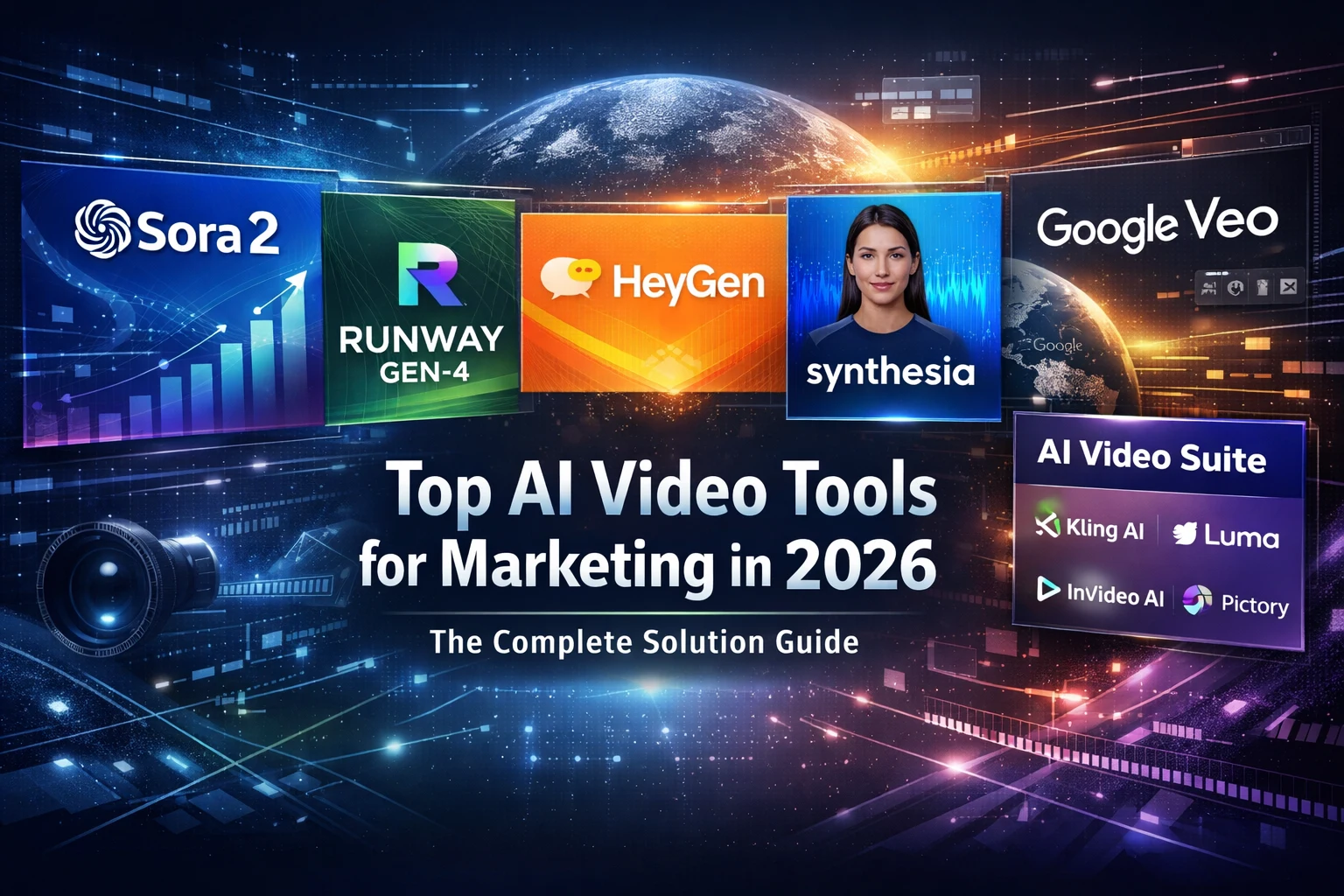
Table of Contents
Introduction: The Video Marketing Reality Check
Your competitors are publishing three videos while you're still stuck in post-production on one. Your boss is demanding more content across more platforms, but your budget hasn't increased. Your team is drowning in video editing timelines while your analytics dashboard screams for fresh content. If this sounds familiar, you're experiencing the central paradox of modern marketing: video content drives unmatched results, yet creating it remains painfully slow and expensive.
The data tells a stark story. According to the latest 2026 research, 91% of businesses now use video as a marketing tool, yet 93% of marketers report that time constraints remain their biggest barrier to creating more video content. Meanwhile, 84% of consumers are actively demanding more video from brands, and 82% of video marketers confirm that video marketing delivers exceptional return on investment. The message is clear: video works, audiences want it, but traditional production methods cannot keep pace with demand.
Enter artificial intelligence video generation tools. These platforms represent the most significant shift in video production since the digital camera, fundamentally transforming how marketing teams create, scale, and distribute video content. This comprehensive guide examines the top AI video tools for marketing in 2026, providing authentic data, pricing transparency, and strategic implementation guidance to help you solve your video production bottleneck once and for all.
Why AI Video Tools Are Non-Negotiable in 2026
The marketing landscape has undergone a seismic transformation. Social media videos account for 82% of all consumer internet traffic in 2026, while 93% of marketers who use video report positive ROI from their efforts. More telling still, 85% of people have purchased a product or service after watching a brand video, and 93% of video marketers confirm that video has increased user understanding of their products and services.
Traditional video production requires extensive resources: cameras, lighting equipment, editing software expertise, voice talent, actors, location scouting, and weeks of post-production work. A single professionally produced 60-second video can cost between $3,000 and $10,000 when accounting for all production elements. For marketing teams expected to produce dozens of videos monthly across multiple platforms and languages, this model is financially and operationally unsustainable.
AI video tools eliminate these barriers by automating complex production tasks, compressing timelines from weeks to minutes, and reducing costs by up to 90%. These platforms leverage machine learning, computer vision, and natural language processing to generate professional-quality video content from simple text prompts, static images, or existing footage. The technology has matured dramatically, with 75% of video marketers now using AI tools to help create marketing videos, and the results are indistinguishable from traditional production in many use cases.
The business case extends beyond cost savings. AI video tools enable personalization at scale, allowing marketers to create hundreds of video variants tailored to different audience segments, languages, and platforms without proportionally increasing production time or budget. For global brands, this means creating localized content in 30-plus languages while maintaining consistent brand messaging. For B2B companies, this means personalizing sales videos for individual prospects. For e-commerce brands, this means generating product demonstration videos for thousands of SKUs.
The Top AI Video Tools for Marketing in 2026
1. OpenAI Sora 2: Cinematic Text-to-Video Generation
OpenAI launched Sora 2 in September 2025, and it quickly became the benchmark for cinematic AI video generation. Unlike earlier text-to-video tools that struggled with physics and temporal consistency, Sora 2 generates videos that understand real-world motion, gravity, lighting, and object permanence.
Core Capabilities:
Sora 2 generates videos up to 25 seconds in length at 1080p resolution directly from text descriptions. The platform's breakthrough feature is synchronized audio generation, automatically creating sound effects, ambient noise, and even dialogue that matches the visual action. The physics engine has dramatically improved, modeling complex interactions like fluid dynamics, reflection, and realistic object behavior rather than the morphing and teleportation issues that plagued earlier AI video models.
The Character Cameo feature allows users to create AI-generated versions of themselves through a quick face scan and voice sample, then insert their likeness into any generated scene with remarkable fidelity. This opt-in system includes privacy safeguards and notifications when someone uses your likeness. For marketing teams, this means creating spokesperson videos without scheduling talent, location shoots, or dealing with reshoots.
The platform's most significant development is OpenAI's partnership with Disney, announced in December 2025. This agreement grants Sora the ability to generate content featuring over 200 licensed Disney, Marvel, Pixar, and Star Wars characters with proper intellectual property protection. For brands creating educational content, fan engagement campaigns, or licensed promotional materials, this represents unprecedented creative possibilities with legal certainty.
Best Use Cases:
Sora 2 excels at creating concept videos for campaign pitches, generating B-roll footage for documentary-style content, producing social media advertisements with specific brand aesthetics, and creating cinematic product launches that would traditionally require expensive location shoots and equipment.
Pricing:
Access to Sora 2 requires either a ChatGPT Plus subscription at $20 per month, which includes 50 videos at 480p resolution monthly, or a ChatGPT Pro subscription at $200 per month, which provides 10 times more usage, higher resolutions up to 1080p, and extended video durations up to 25 seconds.
Limitations:
Sora 2 still occasionally struggles with complex extended sequences and fine motor control in hands and faces. The platform works best for scenarios where slight imperfections won't undermine credibility. It remains unsuitable for projects requiring frame-perfect accuracy or highly specific choreographed movements.
2. Runway Gen-4: Professional Video Editing with AI Assistance
Runway has evolved from a simple video generator into a comprehensive creative suite that combines AI generation with professional editing controls. Gen-4, released in 2025, represents the platform's most advanced video generation model, offering unprecedented temporal consistency and motion control.
Core Capabilities:
Runway Gen-4 provides text-to-video, image-to-video, and video-to-video transformation capabilities. The Motion Brush tool allows creators to selectively animate specific elements within a frame, providing granular control over how objects move through scenes. Camera Control enables precise specification of camera movements, angles, and focal lengths, replicating professional cinematography techniques without physical equipment.
The platform includes advanced features like Act-Two for performance capture, enabling facial expression and movement transfer from reference footage to generated content. The Lip Sync tool creates talking-head videos with accurate mouth movements synchronized to audio scripts. Additional capabilities include green screen removal, inpainting to remove unwanted elements, and 4K upscaling for final export quality.
Runway's Workflows feature automates repetitive production tasks by chaining multiple operations together. Marketing teams can build automation sequences that generate initial video, apply brand-specific color grading, add text overlays with product information, and export in multiple aspect ratios for different platforms, all executed as a single process.
Best Use Cases:
Runway Gen-4 serves professional video editors and creative teams who need sophisticated control over their output. It excels at storyboarding and previzualization for larger productions, creating stylized B-roll footage with specific aesthetic requirements, producing social media advertisements with precise brand guidelines, and generating product demonstration videos with controlled camera movements.
Pricing:
Runway operates on a credit-based model. The Free plan offers 125 credits monthly with 720p output and watermarks. The Standard plan costs $12 per month and provides 625 credits (approximately 52 seconds of Gen-4 video or 125 seconds of Gen-4 Turbo). The Pro plan at $28 per month includes 2,250 credits, 4K rendering, custom voice creation, and 500GB storage. The Unlimited plan at $76 per month provides 2,250 fast-queue credits plus unlimited relaxed-queue generation, making it suitable for high-volume production.
Limitations:
Runway's credit system requires careful management, as credits expire monthly without rollover. The platform has a steeper learning curve than simpler tools, making it less ideal for teams without video editing experience. Video resolution is currently capped at 720p for AI-generated content, with 4K available only for upscaling.
3. HeyGen: AI Avatar Videos with Global Translation
HeyGen specializes in avatar-based video creation, making it the premier choice for teams producing spokesperson videos, training content, product demonstrations, and sales outreach at scale.
Core Capabilities:
HeyGen's Avatar IV technology creates ultra-realistic digital spokespersons with natural head movements, blinking patterns matching human behavior, and sophisticated hand gestures. The platform offers over 120 stock avatars representing diverse ethnicities, ages, and professional contexts. More powerfully, the Custom Avatar feature allows users to upload their own photos and voice samples to create personalized digital twins that represent their likeness with high fidelity.
The platform's standout capability is real-time translation with lip sync accuracy. Marketing teams can generate a video in English, then automatically create versions in 175-plus languages and dialects with the avatar's mouth movements perfectly synchronized to the new audio. This dramatically reduces production time and cost for global campaigns.
HeyGen operates as an end-to-end video creation platform. Users input scripts directly into the interface, select their avatar and background, choose voice characteristics, and generate complete videos without external editing software. The platform includes customizable templates for common use cases like product announcements, customer testimonials, and social media posts.
Best Use Cases:
HeyGen excels at creating training videos for corporate learning and development programs, producing personalized sales videos for outreach campaigns, generating product explainer videos for e-commerce stores, creating multilingual content for global marketing campaigns, and developing social media content with consistent on-screen talent.
Pricing:
HeyGen offers a free plan with three one-minute videos per month and limited features. The Creator plan costs $29 per month ($24 when billed annually) and provides unlimited videos up to five minutes each with 1080p export. The Business plan starts at $39 per seat per month (minimum two seats) and includes advanced features like Voice Director for custom vocal performances and priority rendering.
Limitations:
While HeyGen's avatars have improved dramatically, they still occupy an uncanny valley for some viewers, particularly in closeup shots. The platform works best for informational content rather than emotional storytelling. Interactive avatars require higher-tier plans, and the credit system for Avatar IV usage can become expensive for very high-volume production.
4. Synthesia: Enterprise-Grade AI Avatar Platform
Synthesia pioneered the AI avatar video space and remains the market leader for enterprise deployments, offering the most mature feature set, compliance certifications, and security controls.
Core Capabilities:
Synthesia provides access to 240-plus professional AI avatars with expressive capabilities that adapt tone of voice, body movement, and facial expressions based on script context. The platform's Expressive AI Avatars represent a significant advancement, adjusting their performance automatically to match emotional content in the script, conveying sadness in unfortunate scenarios or enthusiasm when discussing positive outcomes.
The platform emphasizes collaboration and workflow management. Teams can create videos together in real-time or asynchronously, leaving comments, managing version history, and working across multiple projects simultaneously. Enterprise-grade features include user roles and permissions, workspace organization, SSO integration, and comprehensive audit logs.
Synthesia's security posture sets it apart from competitors. The platform maintains SOC 2 Type II compliance, GDPR adherence, and ISO 42001 certification. Custom avatars require explicit human consent through a verification process, and content moderation prevents creation of harmful material. For regulated industries like financial services, healthcare, and government, these certifications make Synthesia the only viable choice.
Best Use Cases:
Synthesia serves enterprise marketing teams, corporate communications departments, learning and development organizations, and agencies managing multiple clients. It excels at creating standardized training content across large organizations, producing consistent internal communications from executives, generating compliance training videos for regulated industries, and developing sales enablement materials with predictable quality.
Pricing:
Synthesia offers a free Basic plan with three minutes of video per month. The Starter plan costs $29 per month and includes 120 minutes of video annually with watermark-free exports. The Creator plan at $89 per month provides 360 minutes annually with custom avatars and priority support. Enterprise plans include custom pricing with unlimited seats, advanced integrations, dedicated success teams, and tailored compliance requirements.
Limitations:
Synthesia's avatar library, while extensive, offers less stylistic variety than some competitors. The platform focuses on professional, polished presentation rather than casual or trendy aesthetics. Pricing can become expensive for small teams producing high volumes of content, and the platform lacks some of the creative generation features found in tools like Runway or Sora.
5. Google Veo 3: Photorealistic 4K Video Generation
Google's Veo 3, released through Google AI Studio and integrated into Google's Gemini ecosystem, represents the cutting edge of photorealistic video generation with commercial-grade output quality.
Core Capabilities:
Veo 3 generates videos up to two minutes in length at 4K resolution with native audio generation. The model was trained on extensive YouTube data, giving it exceptional understanding of real-world motion, lighting, and physics. The output quality approaches broadcast standards, with accurate rendering of complex textures, realistic lighting behavior, and coherent motion across extended sequences.
The platform integrates with Google's broader AI ecosystem. Users can access Veo 3 through Gemini for conversational video generation or through Google Flow for more structured filmmaking workflows. Flow provides storyboard tools, scene management, and the ability to chain multiple generated clips into longer sequences while maintaining visual consistency.
Veo 3's commercial rights framework makes it particularly valuable for advertising and marketing applications. The platform provides clear licensing for business use, and the 4K output quality meets technical requirements for broadcast advertising, digital out-of-home displays, and premium web placements.
Best Use Cases:
Veo 3 excels at creating premium advertising content for paid media campaigns, generating product showcase videos requiring photorealistic rendering, producing brand storytelling content with cinematic aesthetics, creating visual effects and animated sequences for larger video productions, and developing concept videos for high-stakes presentations.
Pricing:
Google Veo 3 requires a Google AI Pro subscription at $19.99 per month, which includes 1,000 credits monthly. Videos are watermarked at this tier. Pricing and credit allocations continue evolving as Google expands commercial availability of the platform.
Limitations:
Veo 3's integration into Google's ecosystem means it works best for teams already using Google Workspace and related tools. The platform is newer to market than established competitors, so the feature set and documentation continue maturing. Access remains somewhat limited compared to more established platforms.
6. Additional Tools Worth Considering
Kling AI offers exceptional value for budget-conscious teams, providing high-quality video generation at competitive pricing with strong motion consistency and realistic output.
Luma Dream Machine specializes in rapid generation for social media content, producing videos in minutes rather than hours with lower per-clip costs than many competitors.
InVideo AI transforms written content directly into complete videos with stock footage, voiceovers, and subtitles, making it ideal for repurposing blog posts and articles into video format.
Pictory converts long-form content into short, shareable clips automatically, solving the challenge of creating multiple social media videos from webinars, podcasts, and presentations.
Comprehensive Comparison: Finding Your Best Fit
| Tool | Best For | Starting Price | Key Strength | Main Limitation |
|---|---|---|---|---|
| Sora 2 | Cinematic concepts, B-roll | $20/month (Plus) | Physics accuracy, synchronized audio | Occasional consistency issues |
| Runway Gen-4 | Professional editing, creative control | $12/month | Advanced motion controls, workflows | Credit management complexity |
| HeyGen | Avatar videos, global translation | $29/month | Realistic avatars, 175+ languages | Uncanny valley in closeups |
| Synthesia | Enterprise compliance, training | $29/month | Security certifications, collaboration | Higher cost for high volume |
| Veo 3 | Premium advertising, 4K output | $19.99/month | Photorealistic quality, broadcast ready | Limited commercial availability |
How to Choose the Right AI Video Tool for Your Marketing Team
Selecting the optimal AI video platform requires aligning tool capabilities with your specific marketing objectives, existing workflows, and resource constraints. Consider these strategic factors:
Content Volume and Frequency: Teams producing fewer than five videos monthly can succeed with entry-level plans from any platform. Organizations creating daily content for multiple channels should prioritize unlimited generation plans from Runway or comprehensive credit packages from HeyGen.
Production Complexity Requirements: Simple spokesperson videos and product demonstrations work well with HeyGen or Synthesia. Marketing campaigns requiring creative visual effects, specific camera movements, or stylized aesthetics demand the advanced controls in Runway Gen-4. Concept development and artistic exploration benefit most from Sora 2's generative capabilities.
Global Market Presence: Companies operating in multiple linguistic markets gain exceptional value from HeyGen's translation features, enabling creation of dozens of language variants from a single master video. The alternative requires hiring multilingual voice talent and managing separate production workflows for each market.
Compliance and Security Posture: Regulated industries including financial services, healthcare, pharmaceutical, and government sectors require Synthesia's SOC 2 Type II compliance and comprehensive audit capabilities. Non-regulated sectors can prioritize features and cost over certification requirements.
Team Technical Sophistication: Marketing teams without video editing experience should start with user-friendly platforms like HeyGen or Synthesia, which provide template-based workflows and intuitive interfaces. Teams with video production backgrounds can leverage Runway's advanced features and creative controls to maximum advantage.
Budget Allocation Strategy: Calculate your effective cost per video across different pricing models. Credit-based systems favor occasional use but become expensive at high volumes. Unlimited plans provide predictability for consistent production schedules. Factor in the hidden costs of traditional production including talent fees, equipment rental, location costs, and editing time to calculate true ROI.
Implementation Strategy: Getting Started Successfully
Successful AI video tool adoption requires strategic implementation rather than simply purchasing software and hoping for results. Follow this structured approach to maximize your investment:
Phase One: Pilot and Proof of Concept (Weeks 1-4)
Begin with a single use case that addresses a clear pain point. Many teams start with testimonial videos, product demonstrations, or social media announcements because these formats have predictable requirements and measurable outcomes. Create 10-20 test videos using free or entry-level plans from two to three platforms to evaluate quality, workflow efficiency, and team comfort level.
Phase Two: Process Development (Weeks 5-8)
Document your production process including prompt writing guidelines, brand voice specifications, visual style preferences, and quality control checkpoints. Establish clear roles defining who writes scripts, reviews output, and publishes content. Create a library of reusable templates, brand-approved backgrounds, and standard intro-outro sequences to accelerate future production.
Phase Three: Scale and Optimization (Weeks 9-16)
Expand usage to additional content types and distribution channels while tracking performance metrics. Monitor view completion rates, engagement metrics, and conversion data to identify which AI-generated videos perform best. Refine your prompt writing techniques based on output quality patterns. Consider upgrading to higher-tier plans as volume justifies the investment.
Phase Four: Advanced Integration (Week 17+)
Integrate AI video tools into broader marketing automation workflows. Connect generation platforms to content calendars, social media schedulers, and CRM systems. Develop personalization strategies that leverage AI's ability to create hundreds of variants efficiently. Train additional team members to distribute production capacity and build organizational resilience.
Best Practices for Maximizing AI Video Tool ROI
Master the Art of Prompt Engineering: The quality of AI-generated videos correlates directly with prompt specificity and clarity. Effective prompts include detailed descriptions of desired visuals, explicit specifications for camera movement and framing, clear articulation of mood and tone, specific lighting conditions, and relevant style references. Document which prompts consistently generate high-quality output and build a prompt library for your team.
Maintain Brand Consistency: Create brand guidelines specifically for AI video generation including approved color palettes with hex codes, font selections and sizing, logo placement specifications, voice and tone parameters for avatars, and approved background environments. Use these standards to evaluate all AI-generated content before publication.
Combine AI with Human Creativity: The most successful marketing teams use AI for execution efficiency while reserving strategic creative direction for human judgment. Let AI handle script drafting, initial visual generation, and variant creation, while humans provide creative concept development, emotional narrative arc design, and final quality assessment.
Optimize for Platform Requirements: Each social media platform has specific technical requirements and audience expectations. Generate separate versions optimized for each channel rather than repurposing identical content. YouTube performs best with 16:9 horizontal videos between 90 seconds and eight minutes. Instagram Reels and TikTok require 9:16 vertical videos under 60 seconds. LinkedIn responds to square 1:1 formats with captions for sound-off viewing.
Measure, Learn, and Iterate: Track performance metrics for AI-generated videos separately from traditionally produced content. Monitor view completion rates, engagement metrics including likes and shares, click-through rates on calls to action, and conversion metrics for purchase or signup goals. Use this data to refine your approach, identifying which content types, styles, and platforms generate the strongest returns.
The Future of AI Video Marketing
The AI video generation landscape continues advancing at remarkable pace. Several emerging trends will shape the next generation of these tools and their marketing applications:
Real-Time Interactive Video: Upcoming platforms will enable viewers to interact with AI-generated video content, choosing their own narrative paths or customizing product demonstrations to their specific interests. This convergence of AI generation and interactivity will transform video from passive consumption to active exploration.
Automated Multi-Platform Optimization: Future tools will automatically generate platform-specific variants from a single master video, handling aspect ratio adjustments, duration optimization, caption generation, and platform-specific formatting requirements without manual intervention.
Advanced Personalization: Next-generation AI video platforms will integrate with marketing automation and CRM systems to generate individually personalized videos at scale, incorporating viewer-specific data including names, company information, usage patterns, and personal preferences into video content.
Improved Character Consistency: Current limitations around maintaining consistent character appearance and behavior across multiple scenes will largely disappear as models improve, enabling creation of long-form narrative content with recognizable protagonists and predictable physics.
Native Integration with Marketing Stacks: AI video tools will embed directly into existing marketing technology stacks including content management systems, social media schedulers, email marketing platforms, and marketing automation tools, eliminating the need to manually export and upload content across platforms.
Conclusion: Your Next Steps
The video marketing bottleneck that has frustrated marketing teams for years now has a practical solution. AI video generation tools have matured from experimental novelties to production-ready platforms capable of generating professional-quality content at unprecedented speed and scale. The data confirms their effectiveness, with 93% of video marketers reporting positive ROI and 82% confirming that video marketing delivers strong returns on investment.
Your specific tool selection depends on your unique requirements. Teams needing cinematic generation should evaluate Sora 2. Organizations requiring professional editing controls should test Runway Gen-4. Companies prioritizing avatar videos and global translation should explore HeyGen. Enterprises demanding compliance certifications should implement Synthesia. Brands seeking photorealistic 4K output should investigate Veo 3.
The most important decision is not which specific platform you choose, but rather the commitment to begin leveraging these tools immediately. Your competitors are already adopting AI video generation, reducing their production costs while increasing output volume. The performance gap between organizations using these tools and those still relying exclusively on traditional production methods will widen dramatically throughout 2026 and beyond.
Start with a pilot project addressing a single use case. Measure results carefully. Refine your approach based on performance data. Scale gradually as you build expertise and confidence. The marketing teams that master AI video generation now will establish significant competitive advantages in attention capture, audience engagement, and conversion optimization that traditional production methods cannot match.
The video marketing revolution is not coming. It is here. The question is whether your organization will lead it or be left behind by it.
About the Data: All statistics, pricing, and feature descriptions in this article are based on publicly available information as of January 2026, including official vendor documentation, third-party research reports, and verified user experiences. Tool capabilities and pricing may change as vendors update their offerings.